Recent Trends Shaping the Global Automotive Industry in 2026
The global automotive industry is undergoing one of the biggest transformations in its history. Vehicle manufacturers, exporters, dealers and customers are adapting to rapid changes in technology, fuel efficiency, environmental regulations, digital connectivity and consumer behaviour.
In 2026, the market is no longer moving towards a single type of vehicle. Instead, petrol vehicles, hybrids, plug-in hybrids and fully electric vehicles are developing side by side. For international vehicle exporters, understanding these trends is essential for selecting the right vehicles for each destination market.
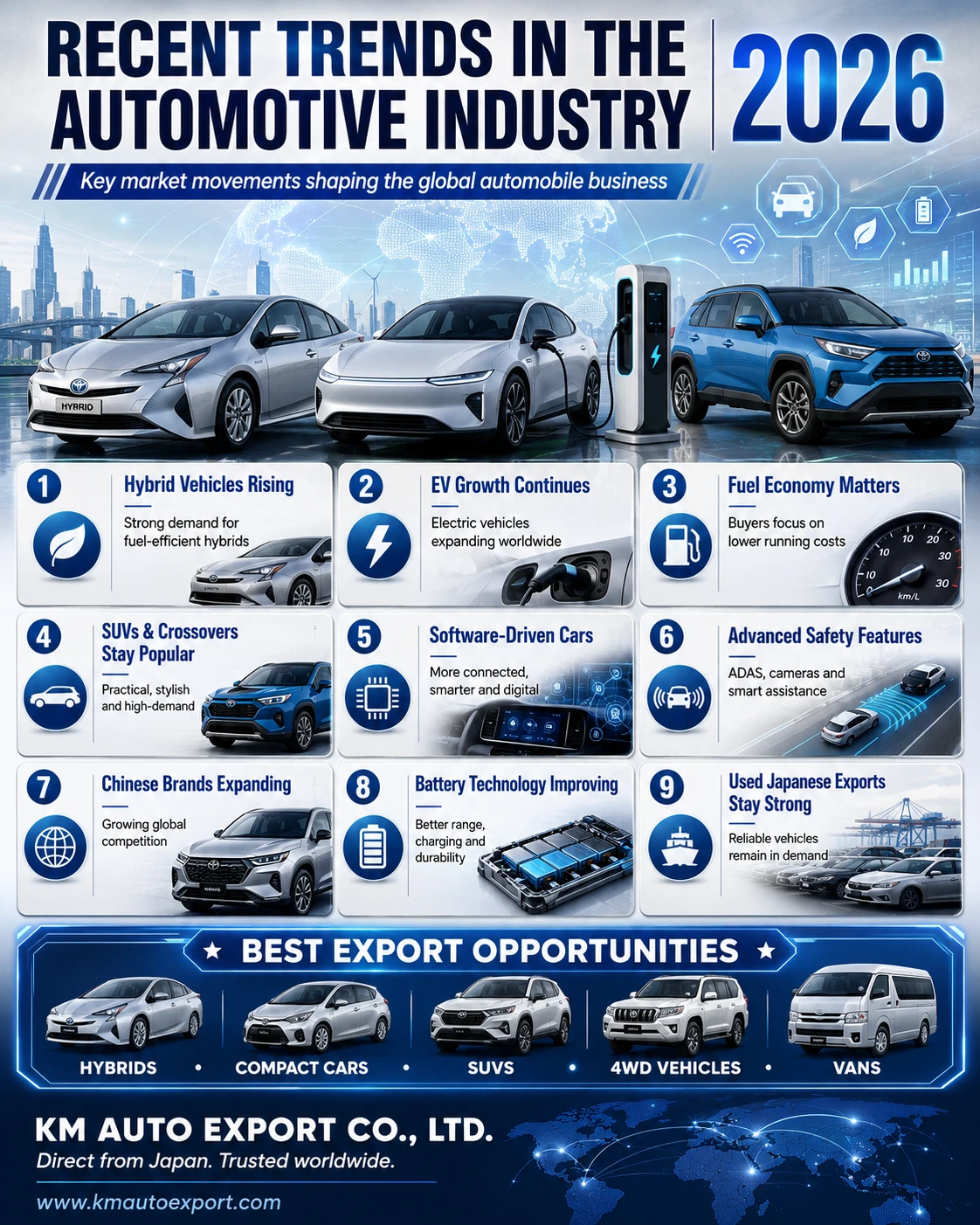
1. Hybrid Vehicles Continue to Grow in Popularity
Hybrid vehicles are currently one of the strongest segments in the global automotive market. Many customers want better fuel economy and lower emissions but are not yet ready to depend completely on electric charging infrastructure.
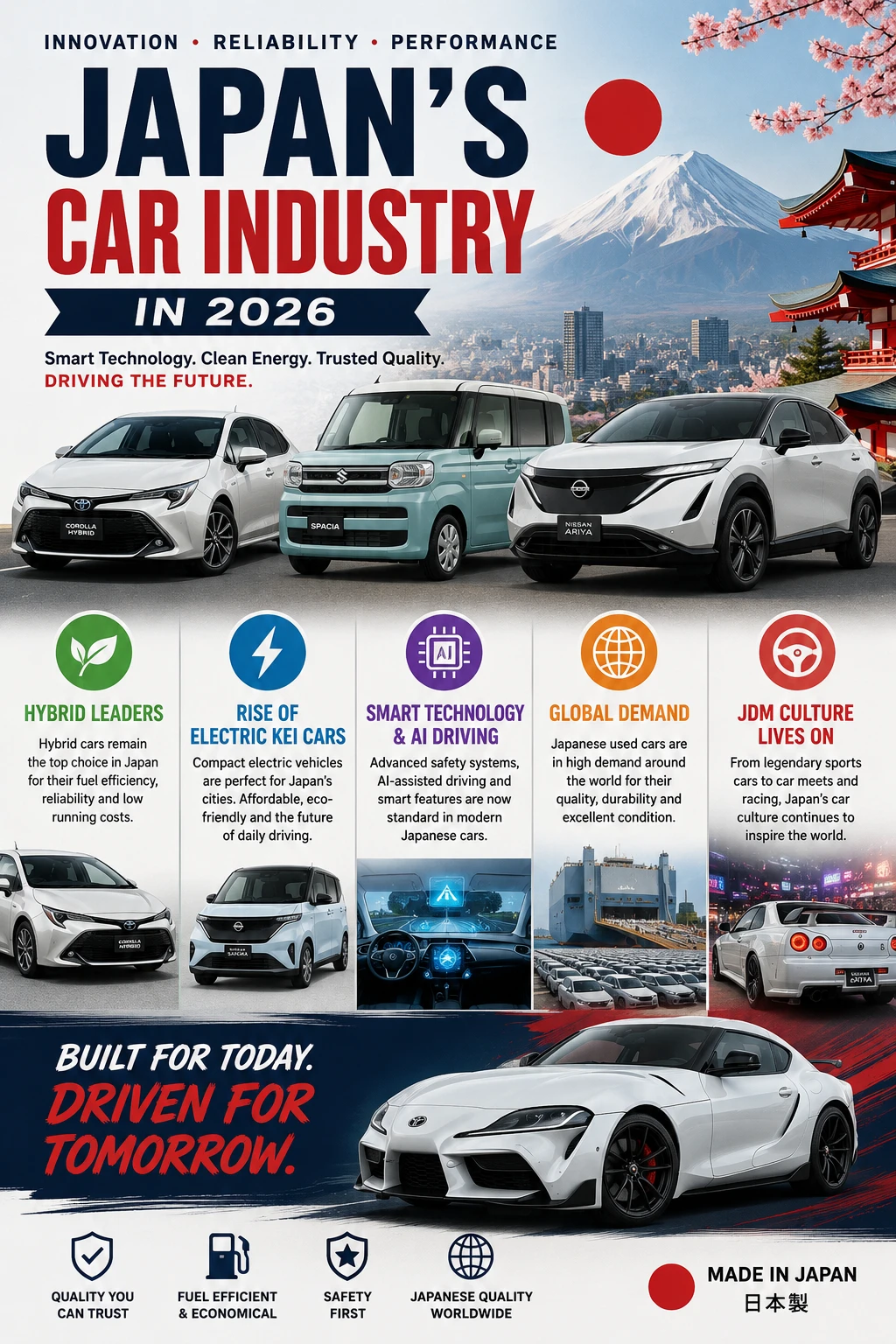
Japanese manufacturers such as Toyota, Honda, Nissan and Mitsubishi have a strong advantage in this category because of their reliable and widely recognised hybrid systems.
Models such as the Toyota Prius, Corolla Cross Hybrid, Yaris Cross Hybrid, Honda Vezel e:HEV and Nissan Note e-POWER are becoming increasingly attractive in international markets.
Hybrid vehicles are especially suitable for countries where fuel prices are high but public charging facilities are still limited.
2. Electric Vehicle Sales Continue to Expand
Electric vehicle sales are continuing to increase worldwide. Battery technology is improving, charging times are becoming shorter and more affordable electric models are entering the market.
However, EV adoption varies significantly from one country to another. China and several European countries have strong charging networks and government support, while many developing markets still face challenges related to electricity supply, charging infrastructure and battery servicing.
For used-vehicle exporters, electric vehicles should therefore be purchased carefully. Battery condition, charging compatibility, spare-parts availability and local technical support should always be checked before export.
3. Customers Are Focusing More on Fuel Economy
Fuel efficiency has become one of the most important purchasing considerations for vehicle buyers.
Customers are increasingly choosing compact cars, small SUVs, hybrid vehicles and efficient petrol engines to reduce daily operating costs. Large-engine vehicles are still popular in certain markets, but demand is gradually moving towards practical and economical models.
Japanese kei cars and compact vehicles remain particularly attractive because of their low fuel consumption, affordable maintenance and easy handling.
Popular examples include:
- Suzuki Alto
- Daihatsu Mira
- Honda N-Box
- Toyota Yaris
- Honda Fit
- Nissan Note
- Toyota Aqua
These models are suitable for both personal use and commercial transportation in many international markets.
4. SUVs and Crossovers Remain in High Demand
SUVs and crossover vehicles continue to dominate many global markets. Customers prefer them because of their higher driving position, spacious interiors, modern styling and improved road capability.
Compact and medium-sized SUVs are especially popular because they combine practicality with reasonable fuel consumption.
Japanese models such as the Toyota RAV4, Toyota Corolla Cross, Honda Vezel, Nissan X-Trail, Mazda CX-5, Mitsubishi Outlander and Subaru Forester continue to attract strong international demand.
Hybrid and four-wheel-drive SUV models are particularly valuable in countries with difficult roads, changing weather conditions or mountainous areas.
5. Vehicles Are Becoming More Software-Driven
Modern vehicles are increasingly controlled by software and electronic systems.
Many new cars now include:
- Digital instrument displays
- Smartphone connectivity
- Remote vehicle applications
- Over-the-air software updates
- Intelligent navigation
- Voice control
- Connected safety services
- Driver-assistance technology
This trend is creating new opportunities but also new challenges for used-car buyers and exporters. Navigation language, software compatibility, mobile network support and regional restrictions should be checked before shipment.
A vehicle may be mechanically reliable but still have electronic features that do not operate correctly in another country.
6. Advanced Safety Features Are Becoming Standard
Safety technology is no longer limited to luxury vehicles. Many compact and mid-range vehicles now include advanced safety systems as standard equipment.
Common features include:
- Automatic emergency braking
- Adaptive cruise control
- Lane-departure warning
- Lane-keeping assistance
- Blind-spot monitoring
- Parking sensors
- 360-degree cameras
- Driver-attention monitoring
- Automatic high-beam headlights
These features are becoming important selling points in both new and used vehicle markets.
Exporters must carefully inspect radar sensors, cameras and warning lights because these systems can be expensive to repair if damaged.
7. Chinese Vehicle Manufacturers Are Increasing Competition
Chinese automotive brands are expanding rapidly in international markets. They are competing through lower prices, modern designs, advanced battery technology and strong digital features.
Brands such as BYD, Geely, Chery, Great Wall Motor and SAIC are increasing pressure on established Japanese, European and American manufacturers.
This competition is encouraging all manufacturers to reduce prices, improve technology and release new models more quickly.
For Japanese vehicle exporters, reliability, auction transparency, vehicle condition and worldwide recognition remain important competitive strengths.
8. Battery Technology Is Improving
Battery technology is one of the most important areas of automotive development.
Manufacturers are working to achieve:
- Longer driving ranges
- Faster charging
- Lower production costs
- Improved battery safety
- Longer battery life
- Better cold-weather performance
- More efficient recycling
Lithium iron phosphate batteries are becoming more common because they are generally less expensive and durable. Solid-state batteries are also being developed and may offer improved range, safety and charging performance in the future.
For used EV exports, battery health reports will become increasingly important. Buyers will want clear information about remaining battery capacity, charging history and possible replacement cost.
9. The Used Japanese Vehicle Export Market Remains Strong
Japanese used vehicles continue to be highly respected around the world.
International buyers choose Japanese vehicles because of:
- Good mechanical condition
- Reliable maintenance history
- Strict inspection standards
- Wide model availability
- Competitive auction prices
- Strong resale value
- Fuel-efficient engines
- Availability of right-hand-drive models
Demand remains strong across Africa, the Caribbean, the Pacific Islands, Asia, the Middle East, Europe and Central Asia.
However, each destination has different import rules. Vehicle age limits, emissions standards, inspection requirements, customs duties and steering-position regulations must be checked before purchasing.
10. Buyers Are Looking Beyond the Purchase Price
Customers are becoming more careful about the total cost of owning a vehicle.
They are no longer considering only the initial purchase price. They are also comparing:
- Fuel consumption
- Maintenance cost
- Spare-parts availability
- Insurance cost
- Battery condition
- Repair complexity
- Resale value
- Vehicle reliability
For this reason, vehicles with simple maintenance, common spare parts and strong resale demand are likely to remain the safest choices for exporters.
11. Online Vehicle Purchasing Is Becoming More Common
More customers are now purchasing vehicles through websites, social media, video calls and digital auction services.
Buyers expect exporters to provide:
- Clear vehicle photographs
- Walk-around videos
- Auction-sheet translations
- Inspection reports
- Shipping updates
- Transparent invoices
- Online payment support
- Quick communication
Trust and transparency are becoming just as important as vehicle price.
Export companies that provide regular updates and accurate vehicle information are more likely to build long-term international customer relationships.
12. Sustainability Is Influencing the Automotive Market
Governments and manufacturers are paying greater attention to environmental responsibility.
The industry is focusing on:
- Lower vehicle emissions
- Recycling vehicle materials
- Reusing EV batteries
- Cleaner production methods
- Sustainable steel and aluminium
- Reduced factory energy consumption
- More efficient transportation and shipping
Used-vehicle exports also support sustainability by extending the useful life of vehicles instead of replacing them prematurely.
A well-maintained used Japanese vehicle can continue operating reliably for many years in another market.
Best Opportunities for Vehicle Exporters
Based on current market trends, the most promising export categories include:
Hybrid Vehicles
Hybrid vehicles offer excellent fuel economy without requiring full dependence on charging infrastructure.
Compact Fuel-Efficient Cars
Small Japanese cars remain ideal for markets where affordability and fuel cost are major concerns.
Compact and Medium SUVs
SUVs provide a strong combination of comfort, practicality, safety and resale value.
Four-Wheel-Drive Vehicles
4WD vehicles remain important in countries with difficult roads, winter conditions and rural areas.
Commercial Vans and People Carriers
Models such as the Toyota Hiace, Nissan Caravan, Toyota Noah, Toyota Voxy, Honda Stepwgn and Nissan Serena continue to have strong demand for business and family transportation.
Carefully Selected Electric Vehicles
EVs offer excellent opportunities in markets with established charging infrastructure, government incentives and professional battery servicing.
Conclusion
The automotive industry in 2026 is being shaped by electrification, hybrid technology, fuel efficiency, digital connectivity, advanced safety systems and changing customer expectations.
However, there is no single vehicle type that is suitable for every country.
Successful vehicle exporters must understand the individual requirements of each market and select vehicles according to local fuel prices, road conditions, charging infrastructure, taxes, spare-parts availability and customer demand.
For many emerging markets, reliable Japanese hybrids, compact petrol vehicles, SUVs and commercial vans are expected to remain among the strongest export opportunities.
KM AUTO EXPORT CO., LTD. continues to source high-quality new and used vehicles directly from Japan for customers worldwide. Through professional auction support, detailed vehicle inspections, secure documentation and international shipping services, we help customers purchase suitable vehicles with confidence.
KM AUTO EXPORT CO., LTD.
Direct from Japan. Trusted worldwide.
Website: www.kmautoexport.com
Instagram: @kmauto_export

KM AUTO
Content WriterKM Auto Export Co. Ltd. is a trusted Japanese vehicle export company supplying quality used and new cars worldwide. We source directly from top auctions and certified dealers across Japan, ensuring every vehicle is carefully inspected and professionally prepared for export. With reliable logistics and full documentation support, we deliver a smooth, transparent, and dependable export experience — building long-term partnerships with customers around the globe.
0 Comments
Drop your comment
Popular Blog